
Stock backtest: Test your screening rules without writing code
Say your rules and you can backtest them. CubeLV builds a backtesting app that keeps every run as its own card, so you can compare win rate, return and maximum drawdown side by side. You decide whether new rules replace the old ones.
Your sentence
Backtest my screening rules over the past three years and tell me the win rate, return and maximum drawdown. Rerun it whenever I change the rules, and ask me before switching to the new rules.
Already using CubeLV? Open it and this sentence is filled into the CEO chat box; press Send to start. New to CubeLV? Sign up, then paste the sentence to the CEO.
The CEO asked these first
Where there was a recommended option, we picked it. Where there was none, we left it to the CEO. You can also type your own answer.
What are your current screening rules? Type them here, or tell me where they are saved.
Typedrevenue up 20% or more year over year, a P/E of 15 or below and net buying by foreign institutional investors over the last 5 days
For win rate and return, what counts as one trade?
PickedEach position held for 20 trading days counts as one trade
The blueprint CubeLV drew
The blueprint is the structure of the whole app: which agent does each step, where the data is kept and which step stops to wait for you. Once the app is built, this is your map of it.
The screenshots are real captures of CubeLV in its Traditional Chinese interface; the names and descriptions on this page are translations.
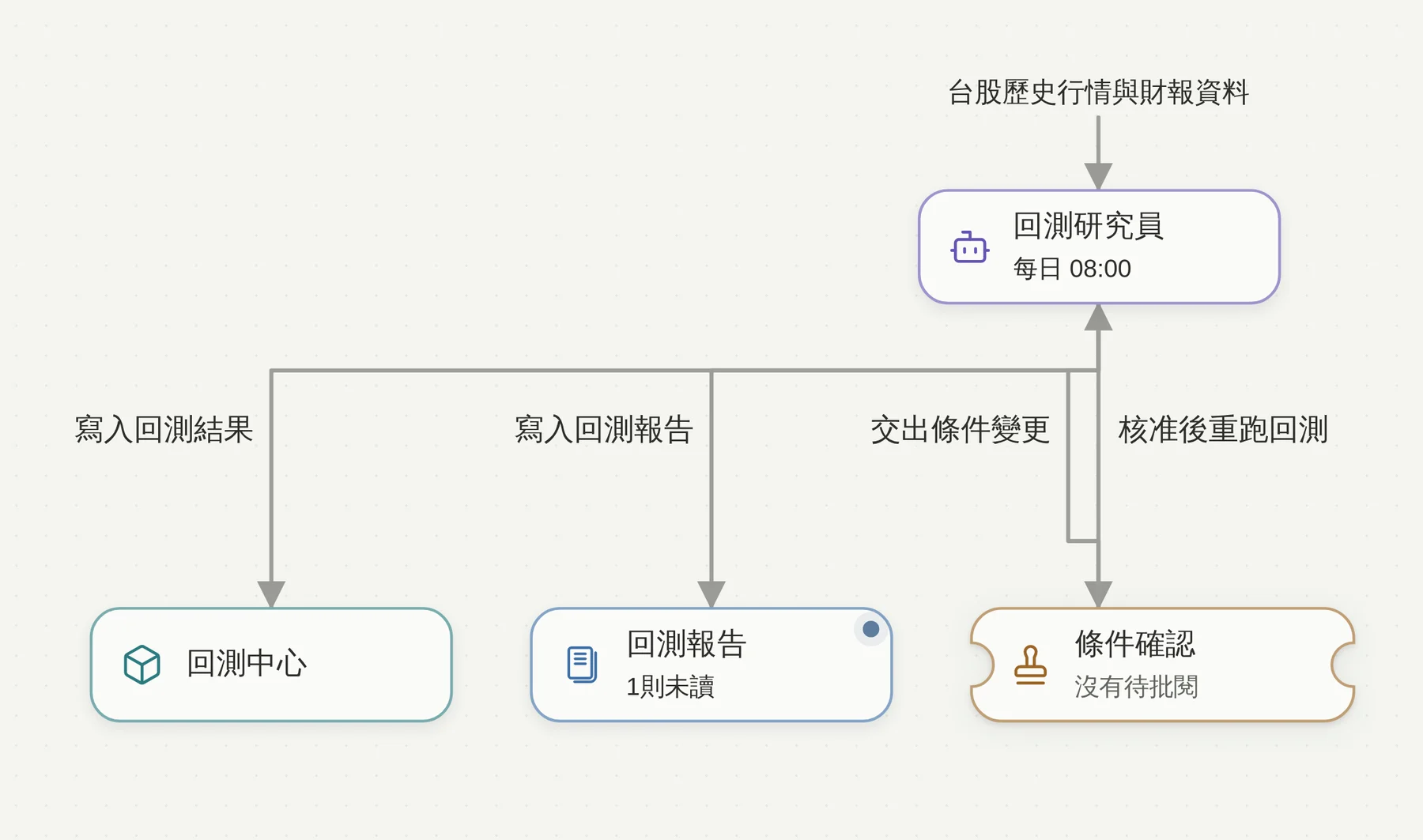
- Data source Taiwan stock price history and financials Three years of prices and financials for TWSE- and TPEx-listed stocks.
- Agent Backtest Researcher Backtests your rules over the past three years and writes win rate, return and maximum drawdown into the Backtest Center and Backtest Reports. When the rules change, it hands you the new rules to confirm.
- Plugin Backtest Center One card per backtest; open one for details, or change the rules and rerun from the bottom right.
- Data Backtest Reports The rules, period and results of each backtest.
- Handoff card Rule Confirmation Asks whether to switch to the new rules; it reruns with them only if you approve.
See the screen drafts before anything is built
Drafts show what the screens will look like. The stocks and numbers in them only fill out the layout and are not recommendations. To change something, point at the draft and say it. Nothing is built until you press “Start building”.
PluginBacktest Center
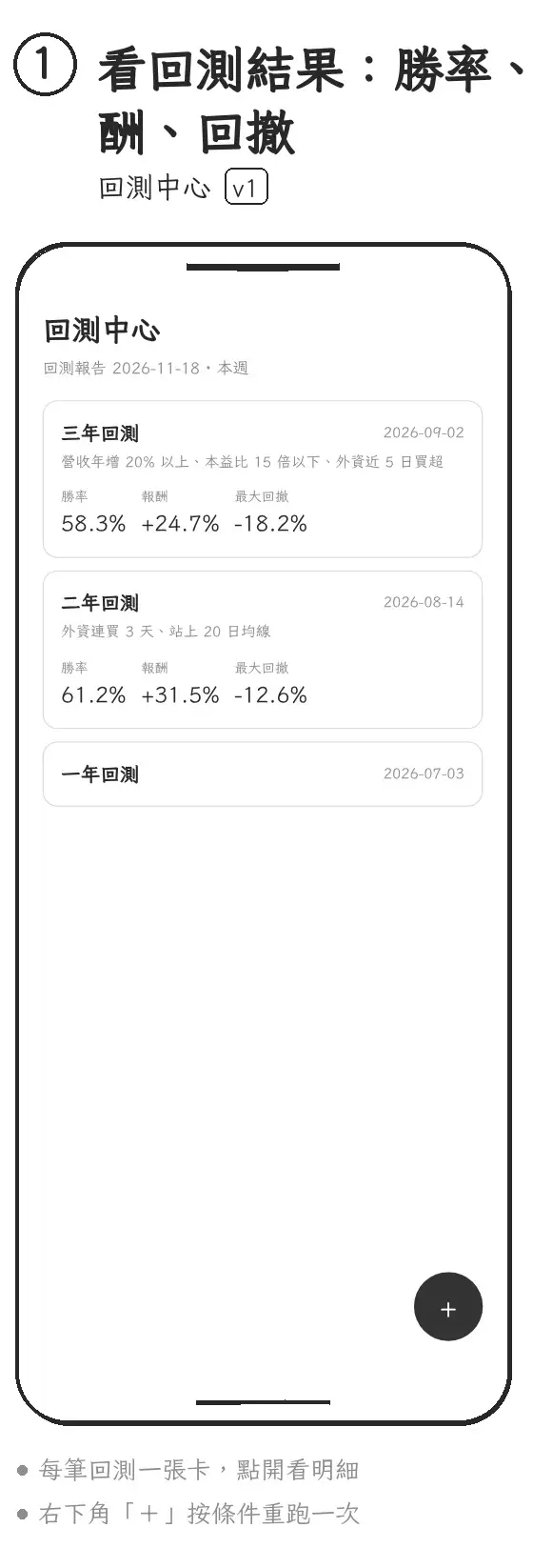
One card per backtest, showing the rules used, win rate, return and maximum drawdown; open a card to see every trade. The “+” at the bottom right runs it again with new rules.
Handoff card: where the app stops for you
Handoff cardRule Confirmation
- When it appears
- When you say you want to change the rules, the Backtest Researcher writes up the new rules on a card under “To review”.
- What the card shows
- Which rules changed
- The backtest period and how each trade is counted
- What to do: type or say your instructions
- What you can press
- Approvererun the backtest with the new rules
- Don't switchkeep the current rules
- Skipno decision this time
Doing it by hand vs. with CubeLV
Fill in field after field in backtesting software, or write code.
Say the rules in one sentence; the CEO first checks how each trade should be counted.
Set everything up and run it again every time.
The Backtest Researcher tests the rules over the past three years and writes the results into the Backtest Center.
Old and new results sit in different files and are hard to compare side by side.
Every backtest is kept as its own card, with win rate, return and maximum drawdown side by side.
You decide after reading, and there is no record of the switch.
A handoff card asks whether to switch to the new rules. It reruns only when you approve, and everything stays on record.
What it does not do
- Backtests use past data. The results do not predict future returns.
- The platform runs backtests of the “enter when the rules are met, exit after holding a set number of days” kind. It does not support portfolio backtests that rebalance every month (the CEO said so up front this time).
- It does not place orders, or say which set of rules is sure to make money.
Start with this sentence, then make the rules your own
Build it as written, let it run for a day, then tell the CEO what to change.
Backtest my screening rules over the past three years and tell me the win rate, return and maximum drawdown. Rerun it whenever I change the rules, and ask me before switching to the new rules.