
Active ETF holdings changes: Adds and trims compared automatically after every close
Taiwan's active ETFs publish their holdings every day. CubeLV builds an app that compares them by itself after every close: what was newly bought, what was added to and what was sold off completely, with research on the stocks that keep getting added.
Your sentence
Every day after the close, compare the holdings published by Taiwan's active ETFs and list the new buys, adds and exits for me. Research stocks that were added three days in a row, and ask me before adding them to my watchlist.
Already using CubeLV? Open it and this sentence is filled into the CEO chat box; press Send to start. New to CubeLV? Sign up, then paste the sentence to the CEO.
The CEO asked these first
Where there was a recommended option, we picked it. Where there was none, we left it to the CEO. You can also type your own answer.
Which active ETFs should it track?
Left to the CEOit picked 00980A, 00981A and 00982A
Is it OK to track these three: 00980A, 00981A and 00982A?
Left to the CEOtrack these three
The blueprint CubeLV drew
The blueprint is the structure of the whole app: which agent does each step, where the data is kept and which step stops to wait for you. Once the app is built, this is your map of it.
The screenshots are real captures of CubeLV in its Traditional Chinese interface; the names and descriptions on this page are translations.
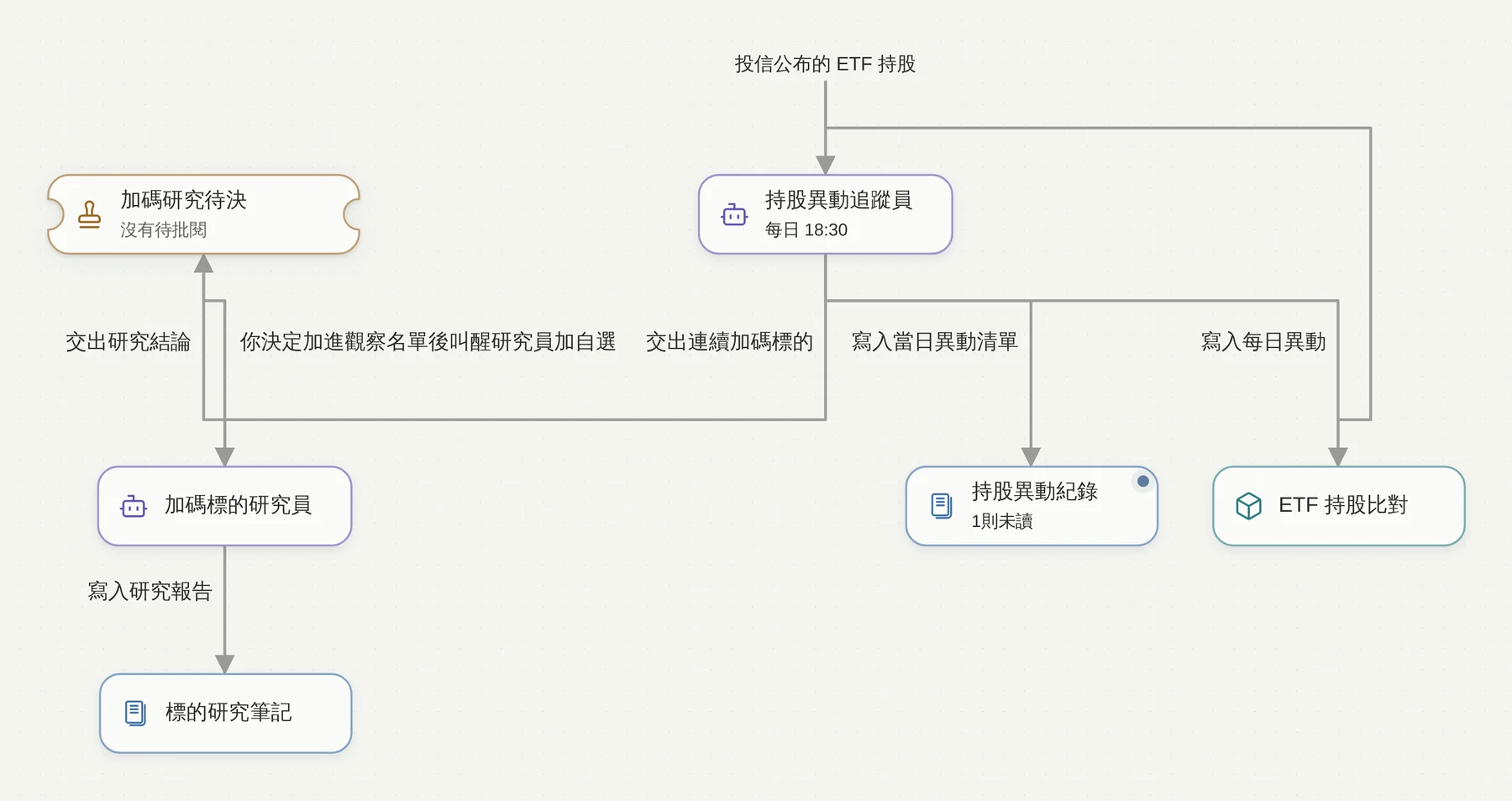
- Data source ETF holdings published by investment trusts (Taiwan's domestic fund managers) The holdings and weights each active ETF publishes every day; the platform can look back a little over two months.
- Agent Holdings Change Tracker At 18:30 every day, compares against the previous holdings date to find new buys, adds and exits and writes them into the change log; stocks added three days in a row go to the researcher.
- Agent Added-stock Researcher Researches stocks that keep getting added, writes a research report and gives its conclusion.
- Plugin ETF Holdings Comparison Today's new buys, adds, exits and repeated adds; tap a stock to see how its weight changed in each ETF.
- Data Holdings Change Log Each day's list of changes.
- Data Stock Research Notes Research reports on stocks that keep getting added.
- Handoff card Add Research Decision Once a stock is researched, stops to ask whether to add it to your watchlist; the researcher adds it only if you say so.
See the screen drafts before anything is built
Drafts show what the screens will look like. The stocks and numbers in them only fill out the layout and are not recommendations. To change something, point at the draft and say it. Nothing is built until you press “Start building”.
PluginETF Holdings Comparison
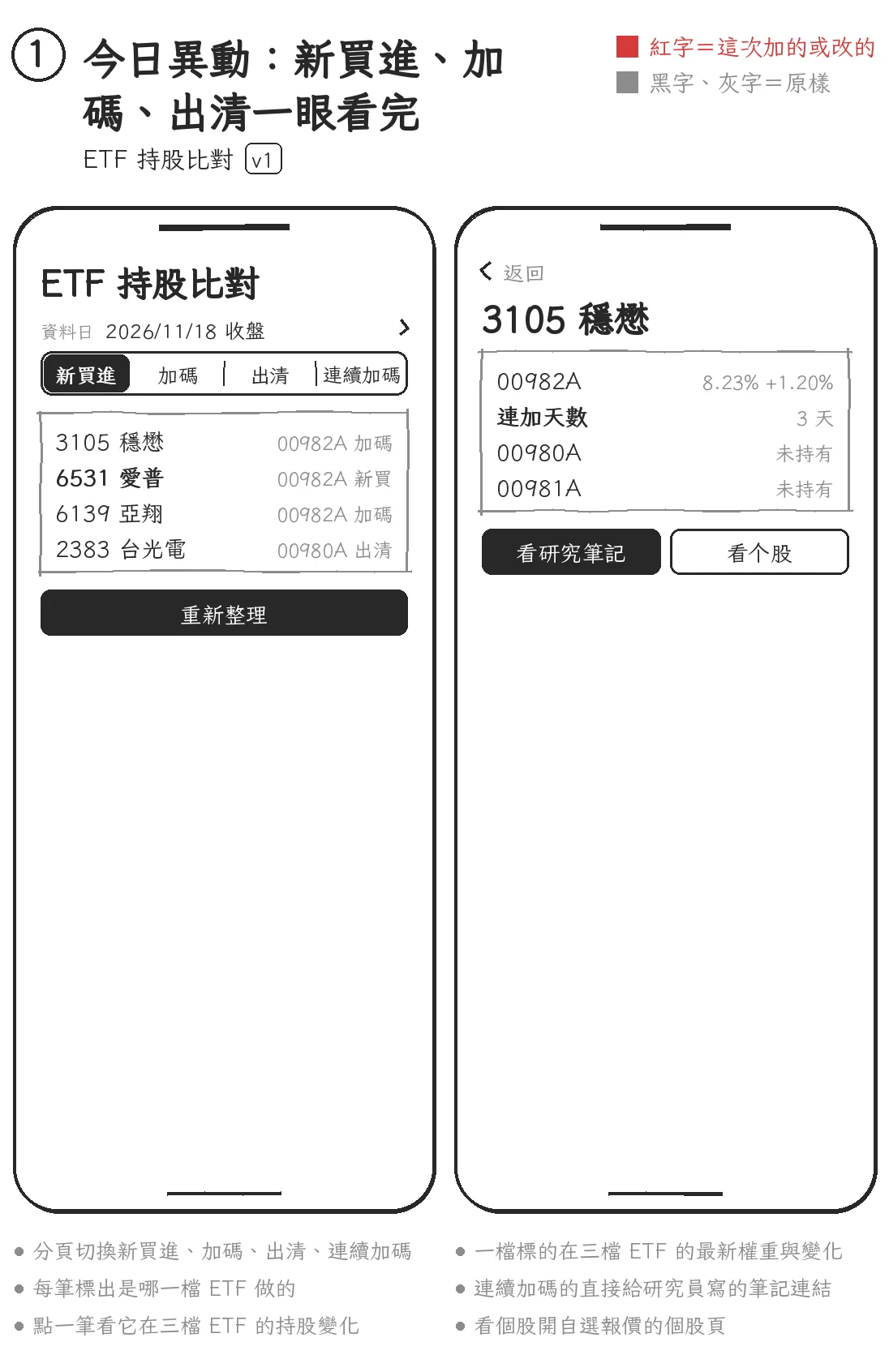
The first screen shows today's changes in four tabs (New buys, Adds, Exits and Repeated adds), each marked with the ETF that made it. The second screen opens one stock with its weight in each of the three ETFs and how many days in a row it was added, then links to the research note or the stock page.
Handoff card: where the app stops for you
Handoff cardAdd Research Decision
- When it appears
- When a stock is added on three holdings dates in a row, the researcher writes a report and opens a card.
- What the card shows
- Which ETFs are adding and for how many days
- How the weights changed
- The research report's conclusion
- What you can press
- Add to watchlistthe researcher adds it to your watchlist
- Don't addstop following this one for now
Doing it by hand vs. with CubeLV
Download each investment trust's daily holdings (PCF) file from its website, one by one.
The platform already has every active ETF's daily holdings, and the agent reads them directly.
Paste today's and yesterday's files into a spreadsheet and match shares and weights one stock at a time.
The Holdings Change Tracker compares them after every close and sorts them into new buys, adds and exits.
You have to go back through several days of files to see it.
It compares back across holdings dates and picks out stocks added three days in a row.
After picking them out, you still look things up and keep notes yourself.
The researcher writes the report first, then a handoff card asks whether to add the stock to your watchlist.
What it does not do
- It does not trade along with the ETFs for you, or say which stock is worth buying.
- It compares holdings as published by investment trusts. Publication lags, so these are not real-time trades.
- You decide which ETFs to track; tell the CEO any time to add or remove one.
Start with this sentence, then make the rules your own
Build it as written, let it run for a day, then tell the CEO what to change.
Every day after the close, compare the holdings published by Taiwan's active ETFs and list the new buys, adds and exits for me. Research stocks that were added three days in a row, and ask me before adding them to my watchlist.